Download Ebook Physical Properties of Crystals: Their Representation by Tensors and Matrices, by J. F. Nye
Considering concerning the perfections will certainly need specific realities as well as views from some sources. Now we provide Physical Properties Of Crystals: Their Representation By Tensors And Matrices, By J. F. Nye as one of the sources to think about. You may not forget that publication is the most effective resource to address your trouble. It could aid you from several sides. When having such issue, obtaining the right publication is much needed. It is making offer and also matched to the issue as well as how to resolve it.
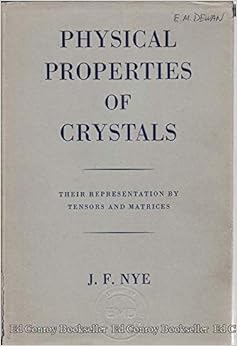
Physical Properties of Crystals: Their Representation by Tensors and Matrices, by J. F. Nye

Download Ebook Physical Properties of Crystals: Their Representation by Tensors and Matrices, by J. F. Nye
Do you feel better after completing a book to check out? What's your sensation when getting a new book once again? Are you tested to review as well as finish t? Excellent visitor! This is the time to conquer your goo practice of reading. We reveal a far better book once again to appreciate. Seeing this site will be likewise packed with readiness to read? It will certainly not make you really feel bored because we have different types as well as type of the books.
How can? Do you think that you don't require sufficient time to opt for purchasing e-book Physical Properties Of Crystals: Their Representation By Tensors And Matrices, By J. F. Nye Don't bother! Merely rest on your seat. Open your device or computer and also be online. You could open or see the web link download that we supplied to obtain this Physical Properties Of Crystals: Their Representation By Tensors And Matrices, By J. F. Nye By this means, you could get the online book Physical Properties Of Crystals: Their Representation By Tensors And Matrices, By J. F. Nye Reviewing guide Physical Properties Of Crystals: Their Representation By Tensors And Matrices, By J. F. Nye by on the internet can be actually done effortlessly by saving it in your computer and also gizmo. So, you could continue every time you have downtime.
To understand how guide will certainly be, it will certainly be connected with the efficiency and also appearance of the book. The subject of guide that you want to read should be associated with the topic that you need or the subject that you such as. Reviewing usual book will not be interested for you even you have actually held in on your hands. This is one trouble to constantly solve. However here, when obtaining Physical Properties Of Crystals: Their Representation By Tensors And Matrices, By J. F. Nye as suggestion, you may not worry anymore.
It is so easy, isn't it? Why don't you try it? In this site, you can likewise discover other titles of the Physical Properties Of Crystals: Their Representation By Tensors And Matrices, By J. F. Nye book collections that may have the ability to help you discovering the very best remedy of your work. Reading this publication Physical Properties Of Crystals: Their Representation By Tensors And Matrices, By J. F. Nye in soft file will certainly likewise reduce you to get the resource quickly. You may not bring for those publications to somewhere you go. Just with the gizmo that constantly be with your anywhere, you could read this publication Physical Properties Of Crystals: Their Representation By Tensors And Matrices, By J. F. Nye So, it will be so promptly to finish reading this Physical Properties Of Crystals: Their Representation By Tensors And Matrices, By J. F. Nye
First published in 1957, this classic study has been reissued in a paperback version that includes an additional chapter bringing the material up to date. The author formulates the physical properties of crystals systematically in tensor notation, presenting tensor properties in terms of their common mathematical basis and the thermodynamic relations between them. The mathematical groundwork is laid in a discussion of tensors of the first and second ranks. Tensors of higher ranks and matrix methods are then introduced as natural developments of the theory. A similar pattern is followed in discussing thermodynamic and optical aspects.
Read more
Product details
Hardcover: 338 pages
Publisher: Oxford: At the Clarendon Press; 1st Edition edition (April 1985)
Language: English
ISBN-10: 0198511051
ISBN-13: 978-0198511052
Package Dimensions:
9.1 x 6.6 x 1.1 inches
Shipping Weight: 1.7 pounds
Average Customer Review:
4.8 out of 5 stars
9 customer reviews
Amazon Best Sellers Rank:
#219,450 in Books (See Top 100 in Books)
This is an amazing text. Nye methodically and somewhat rigorously presents the arguments behind why certain property tensors take on specific characters for different crystalline materials. Nye is uncannily lucid in his explanations- don't worry if you have trouble with tensors. Nye has an amazing introduction in this book (I think because he ties things to geometric interpretations rather than algebraic). Similarly, if you aren't familiar with the physics related to the property, or it has been a while, Nye briefly reviews what is relevant and where in the governing equations the properties fit. I would recommend as a prerequisite an Introduction to Crystallography, especially if you are a little rusty on your crystal systems. Nye does give a brief summary, but I found it a little lacking.As far as the main subject of the book, for example, thermal conductivity is actually a second-rank tensor, but for the materials most often encountered (by engineers, anyway), it reduces to a scalar times the identity tensor. This, as well as other properties, reflect the underlying symmetry of the crystalline lattice, and Nye takes us through why certain components of the tensor are zero. This generalizes for higher-rank tensors such as elastic stiffness/compliance, or piezo-x effects, and all are discussed. It is more than just the symmetry of the lattice, however; there are thermodynamic arguments to be made as well, and Nye hits the high points of these as well. He also gives values for the different constants at room temperature for different materials, and in some cases discusses issue with the measurement of the constants (but really, there are better books for this, like Elastic Constants and Their Measurements).If you are a materials scientist or an engineer/mechanician doing work with solids, this book definitely belongs dog-eared on your bookshelf. I can't recommend this enough.
This book is good for people who has some idea about space groups and point groups in crystallography. Knowledge of those is not necessary but makes it much easier for people who does have that knowledge. Being from mechanical background I have not studied symmetry groups yet. Also, determining properties of second rank tensors by comparing them to quadrics was a little confusing for me since my math background is not that strong. It's an excellent book otherwise for understanding how crystal properties depend on the inherent symmetries present in a crystal and how by reducing the number of independent constants the math can be simplified to a great extent. The book was recommended to me to study wave propagation in anisotropic media. Hearmon's book An Introduction to Applied Anisotropic Elasticity. was more suited towards that once you know the number of independent elastic constants for a particular crystal lattice. If you are interested in knowing how to determine the independent constants, Love's book A Treatise on the Mathematical Theory of Elasticity (Dover Books on Engineering) has a good account of that.
Has a great explanation of Einstein summation notation in it. Its also a super easy and informative read. Assuming you have knowledge of E&M and similar topics.
This book was recommended to me by a graduate student. It is really the first book I've found which presents tensors in a useful and understandable fashion. Would strongly recommend it.
If you are looking to understand this material, and have a background in materials, this is the book to buy.
Because it's difficult or impossible to calculate the properties of solid matter by use of quantum mechanics ("ab initio method"), scientists and engineers turn to alternative methods. One such method, continuum mechanics, assumes that the material under consideration is continuously distributed throughout its volume and completely fills the space it occupies. Obviously this assumption is false: in reality, the atoms of a solid are arranged in symmetrical patterns called crystals (with the exception of glasses) and there is considerable space between the atoms. Properties of the unit cell of each crystal can be measured (with respect to appropriate reference axes), and the data can be put to use by scientists and engineers. In this method, the physical and chemical properties are represented by tensors and matrices. But let's be clear: the experimental values have to be input as components of a tensor--the theory does not in any way allow us to actually calculate the properties of matter. Furthermore, the tensor relates the response to the applied force in a linear manner. Thus the nonlinearity of many phenomena cannot be captured by this method (although there are valiant attempts to use second and higher order effects, as per a Taylor series expansion). Also, the components of the tensor are assumed to be constant, but in many cases they are not. Finally, the orientation of the crystal is arbitrary (though usually certain conventions are followed), which means that the components of the tensor are coupled with the choice of reference axes and will change with a different choice.What I like about Prof. Nye's book is that he admits all of this up front, unlike some other books on material tensors or continuum mechanics. On p. xvi of the Introduction, he says "It is, of course, part of the task of physics to explain the values of these tensors for any particular crystal in terms of its atomic and crystalline structure. That is, in a sense, the next stage. Here we are less ambitious; we concern ourselves more with the form and general significance of the tensors than with their actual numerical values." Part 1 of the book reviews the basics of vectors and tensors, and states Neumann's Principle ("The symmetry elements of any physical property of a crystal must include the symmetry elements of the point group of the crystal.") Part 2 covers equilibrium properties (paramagnetic and diamagnetic susceptibility, electric polarization, stress and strain and elasticity, and piezoelectricity). Part 3 covers transport properties (thermal and electrical conductivity and thermoelectricity), and Part 4 covers crystal optics and optical activity. Each chapter of each part ends with a summary (and some chapters have an additional summary in the middle). Exercises with real data are scattered throughout the text; solutions to some of them are given in the back of the book. There are numerous appendices, a bibliography, supplementary references and notes, and one index for authors and another for subjects.The treatment of elasticity is traditional: Hooke's Law (which assumes a linear relation between stress and strain) is stated, and a fourth-order tensor is derived. In reality of course, Bridgman's experiments have shown that solid volume is inversely proportional to the square root of the applied pressure. The real variables are pressure and volume, which are scalar. What actually happens is that the applied pressure reduces the interatomic distance between the atoms, but the atomic forces resist this change.Overall, however, this is a very fine book and recommended for all solid-state physicists, chemists, and engineers. Just don't expect to be able to actually calculate the properties of matter with it...
Physical Properties of Crystals: Their Representation by Tensors and Matrices, by J. F. Nye PDF
Physical Properties of Crystals: Their Representation by Tensors and Matrices, by J. F. Nye EPub
Physical Properties of Crystals: Their Representation by Tensors and Matrices, by J. F. Nye Doc
Physical Properties of Crystals: Their Representation by Tensors and Matrices, by J. F. Nye iBooks
Physical Properties of Crystals: Their Representation by Tensors and Matrices, by J. F. Nye rtf
Physical Properties of Crystals: Their Representation by Tensors and Matrices, by J. F. Nye Mobipocket
Physical Properties of Crystals: Their Representation by Tensors and Matrices, by J. F. Nye Kindle
 About the Author


0 komentar: